
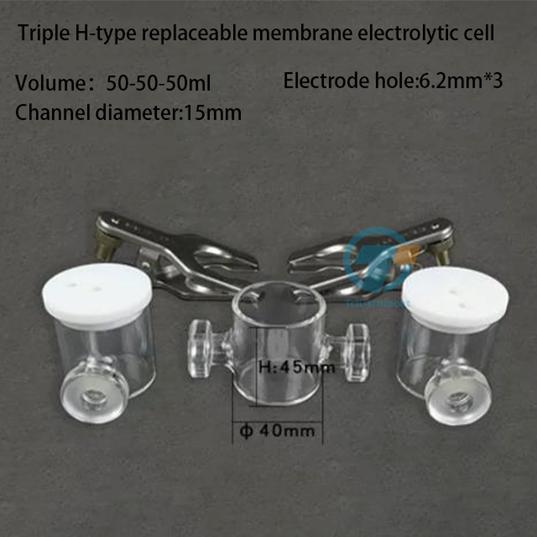
Unsealed three-cell electrochemical cell, glass, 50 ml
Rp123.00
Our unsealed three-cell electrochemical cell is an open-configuration setup used primarily in laboratory research for precise control and measurement of electrochemical reactions under ambient pressure.
Unlike sealed variants, the unsealed cell allows for easy access to the electrolyte and quick repositioning of electrodes.
Standard Configuration: Typically includes a borosilicate glass vessel and a PTFE lid with pre-drilled ports for the three electrodes and gas inlet/outlet lines.
The Three-Electrode System:
Working Electrode (WE): The primary site of the reaction under study.
Reference Electrode (RE): Provides a stable, known potential for accurate measurement without passing current.
Counter (Auxiliary) Electrode (CE): Balances the current generated at the WE to complete the circuit.
Gas Purging: Most designs feature dedicated ports to bubble inert gases (like Nitrogen or Argon) to remove dissolved oxygen, which could otherwise interfere with redox measurements.
Core Applications:
Voltammetric Studies: Ideal for Cyclic Voltammetry (CV) and Linear Sweep Voltammetry to study redox behavior and reaction mechanisms.
Catalyst Screening: Used to evaluate the efficiency and stability of new catalysts for Hydrogen Evolution or CO₂ reduction reactions.
Sensor Development: Testing the sensitivity and selectivity of new electrochemical biosensors and gas sensors.
Corrosion Research: Simulating corrosive environments to assess how different materials or coatings degrade over time.
Academic Teaching: Its open structure makes it a cost-effective and flexible tool for routine laboratory education and fundamental research.